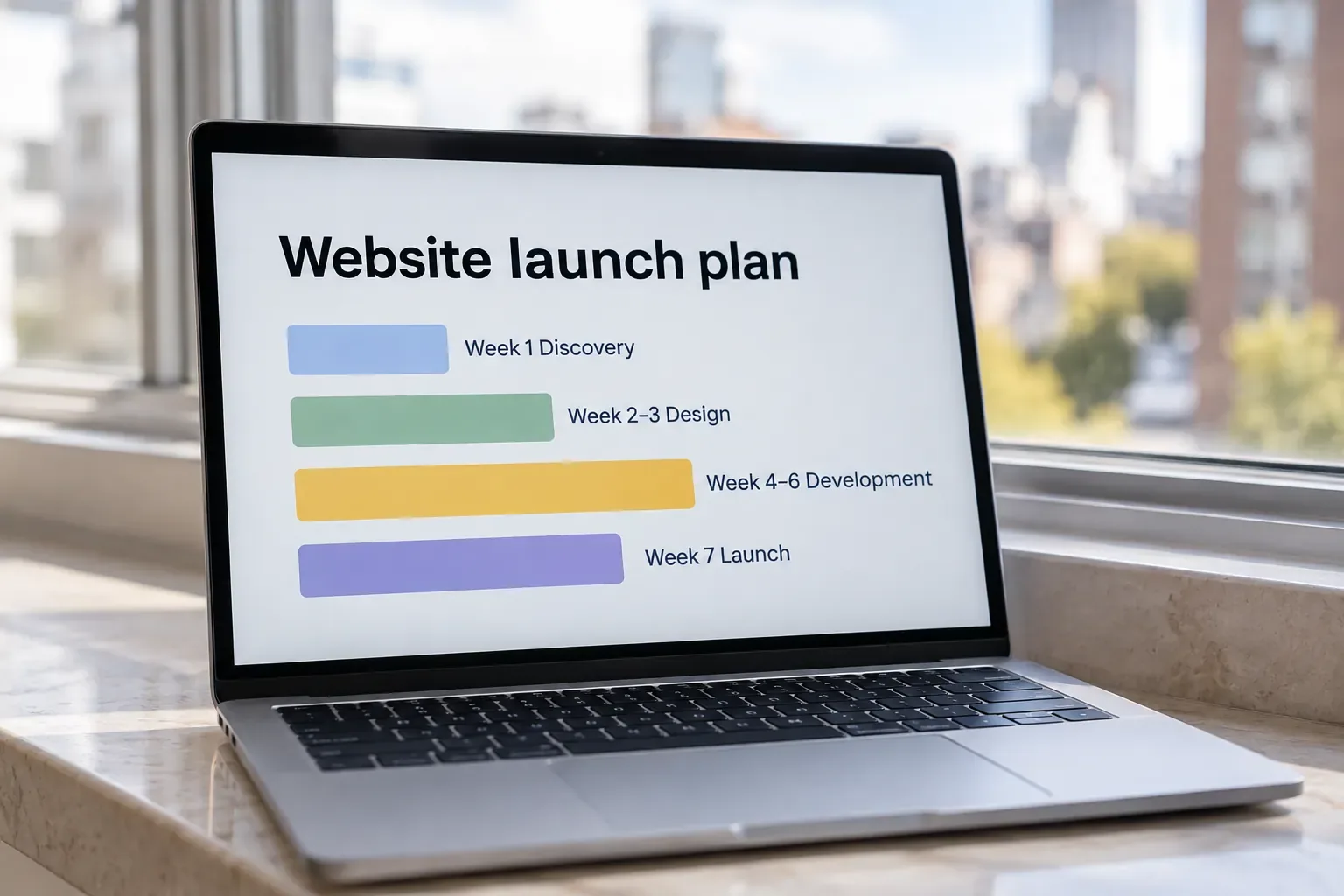
- A landing page takes about a week, a small business site one to two weeks, a corporate site or store three weeks or more.
- Most delays come from content and feedback, not from the build itself.
- Ready texts, photos and access to the domain and hosting at the start shorten the project.
- Agree on the number of revision rounds and the launch checklist before work begins.
Contents 8 sections
- How long does each type of website take?
- What are the stages of building a website?
- What delays a website launch?
- How can you get your website faster?
- Why does an online store take longer?
- How long does a redesign take compared to a new site?
- What happens in the first weeks after launch?
- Should you launch fast or launch complete?
A landing page takes about a week to build, a small business website one to two weeks, and a corporate website or an online store three weeks or more. The build itself is rarely the slow part. Most of the time goes into texts, photos and approvals, so a well-prepared project can launch twice as fast as one that starts without content.
How long does each type of website take?
| Type of site | Our timeline | What takes the time |
|---|---|---|
| Landing page | 5-7 days | Offer, texts and a design that converts |
| Small business website | 7-10 days | Service pages and their texts |
| Corporate website | 14-21 days | Structure, many page types, cases |
| Online store | 14 days to 35+ days | Catalog, filters, payments, shipping, product import |
| Website redesign | 14-21 days | Moving content and keeping search rankings |
These timelines assume the texts and photos are ready or that we write the texts as part of the project, and that feedback on each stage comes within a day or two.
What are the stages of building a website?
- Brief. You answer a written questionnaire about your business, clients, services and competitors. One to two days.
- Structure. We plan the pages and the sections of each page, based on what your clients search for. One to three days.
- Texts. We write the texts for each page or edit yours. This is often the longest stage for multi-page sites.
- Design. We design the key page types and send a link to review. One or two rounds of edits.
- Build. We build the pages, forms and integrations, set up SEO and analytics.
- Testing and launch. We check every page on phones and desktops, test forms, set up redirects from the old site and connect the domain.
Stages overlap. While the design is under review, the texts for the next pages are being written, which keeps the timeline short.
What delays a website launch?
- Content that is not ready. Texts and photos arrive in parts, and the design waits for them.
- Many decision makers. Each stage goes through several people who each add their own edits.
- Scope that grows. New features are added after the design is approved, and the plan has to be redone.
- Missing access. Nobody knows the login to the domain registrar or the old hosting, and the launch waits for a password reset.
- Third parties. A payment provider or CRM needs account verification, which can take days.
How can you get your website faster?
Gather what you can before the project starts. A list of services with prices or price ranges, photos of your work and team, logins for the domain and hosting, and examples of sites you like save days of back and forth. Name one person who approves each stage. Agree on the launch scope and keep new ideas for a second phase after launch.
We work in writing, so every decision stays in one thread and nothing depends on finding a time that suits everyone. You review the design by link and send comments when it suits you, which is convenient across time zones.
Why does an online store take longer?
A store has more parts that must work before the first sale. Products need to be imported with variants, photos and descriptions. Payment through Stripe, PayPal or Shopify Payments needs a verified account. Shipping rates for UPS, FedEx or USPS have to be set up, often through ShipStation or Shippo, and taxes have to be configured for the states where you sell. Each of these depends on accounts in your name, so the timeline includes the time those services take to approve you.
The catalog size matters as well. A store with 30 products can be filled by hand. A store with thousands of products needs an import from a spreadsheet or a supplier feed, with checks for missing photos and broken variants.
How long does a redesign take compared to a new site?
A redesign of a site that already ranks takes about as long as a new site, sometimes longer. The extra work is protecting what you have. Before the build, we list every page that brings search traffic or links, plan where each one goes on the new site and set up 301 redirects for every changed address. After launch, we check Search Console for errors and broken pages. Skipping this step is the main reason a new site loses traffic in the first months.
What happens in the first weeks after launch?
- Indexing. We submit the sitemap in Google Search Console and Bing Webmaster Tools. New pages usually appear in search within days to a few weeks.
- Tracking check. We confirm that form submissions show up as key events in Google Analytics 4 and in your ad accounts.
- Fixes from real use. The first visitors find things tests miss, such as a phone number in the wrong format or a form field that confuses people.
- Content plan. Pages that get impressions in search but few clicks show what to improve next.
Should you launch fast or launch complete?
For most small businesses, launch fast. A site with the main pages, a clear offer and a working form starts collecting data and leads, and you add pages from what visitors actually look for. A blog, extra service pages and a portfolio can follow in the first months. The exception is a site replacing an old one with search traffic, where every important page and its redirect has to be ready at launch. Read how much a small business website costs to see how the same scope choices affect the price.
Questions and answers
Can a website be built in a few days?
A simple landing page or a small site on a ready structure can be built in a few days if the texts and photos are ready and feedback comes quickly. A site with custom design, many pages and integrations needs weeks.
What slows down a website project the most?
Waiting for content and feedback. When texts, photos or approvals take a week each, a two-week project becomes a two-month project. Collect materials before the start and agree on who approves each stage.
Does SEO setup add time to a website project?
A little. Titles, descriptions, redirects from the old site, a sitemap and schema markup add a day or two. Skipping them saves those days but costs search traffic after launch.
Thank you. Share the article with someone who needs it.
Tell us what was missing in the article and we will reply. Ask a question