
Store and CRM
Orders and form leads reach HubSpot, Pipedrive, Zoho CRM or Salesforce with products, contact details, shipping and the ad source.
What we connect Site and CRM
Websites, online stores, apps, integrations and support
Google Ads, Instagram and Facebook, Microsoft Ads, TikTok, ChatGPT and marketplaces
Google Search, Google Maps and answers in ChatGPT, Gemini and Google AI
Instagram and TikTok management, Reels and design
GA4, Google Tag Manager, Conversions API and reports
Chatbots, AI agents, workflow automation and CRM
Email campaigns and automated email sequences
Marketing strategy and a free website audit
Website integration connects your WooCommerce, Shopify, WordPress or Webflow site with your CRM, accounting, payments, shipping, email marketing and marketplaces. Products, stock, prices, orders, payments and shipping labels move between systems without manual entry.
You need an integration when a manager copies orders from the site to the CRM by hand, stock on the site differs from the warehouse or shipping labels are created one by one.
Orders and form leads reach HubSpot, Pipedrive, Zoho CRM or Salesforce with products, contact details, shipping and the ad source.
What we connect Site and CRM
Orders, customers and payments go to QuickBooks or Xero as invoices or sales receipts, so your books match the store without retyping.
What we connect Site and QuickBooks or Xero
The buyer pays by card, Apple Pay or Google Pay through Stripe, PayPal, Square or Shopify Payments, and the payment status appears in the order and the CRM.
What we connect Payments and order status
The buyer sees shipping rates at checkout, and ShipStation or Shippo create the UPS, FedEx, USPS, DHL, Royal Mail, Canada Post or Australia Post label from the order data.
What we connect Site and carriers
Products from your site or inventory go to Amazon, eBay and Etsy with prices, stock and attributes, and stock stays in sync between channels.
What we connect Site and Amazon, eBay, Etsy
Customers, orders and viewed products go to Klaviyo or Mailchimp for welcome, abandoned cart and repeat purchase emails.
What we connect Store and Klaviyo or Mailchimp
If you do not have a CRM yet, you first need to choose one and set up the sales stages. That is a separate service in the automation section.
About CRM implementationWhat exactly is transferred depends on the system and your process, so we fix the data list and sync frequency after the brief.

Before development we agree which system is the source of truth for each type of data. For example, prices and stock live in your inventory system, and the site shows them. We launch one integration in 3+ days.
We find out which systems you use and who works with them. We draw a map of where products, orders, payments and shipping labels come from and where they go.
We get the API keys and match products by SKU, order statuses, shipping methods and payment methods in both systems.
We install a ready-made app or plugin if it is reliable for your platform, or build the sync through the API. We set how often stock and prices update based on the system and the number of products.
We place test orders with different payment and shipping methods and check payments, labels and statuses in the CRM.
We turn on the sync on the live site and give your managers written instructions on where to see orders and what to do if something did not transfer.
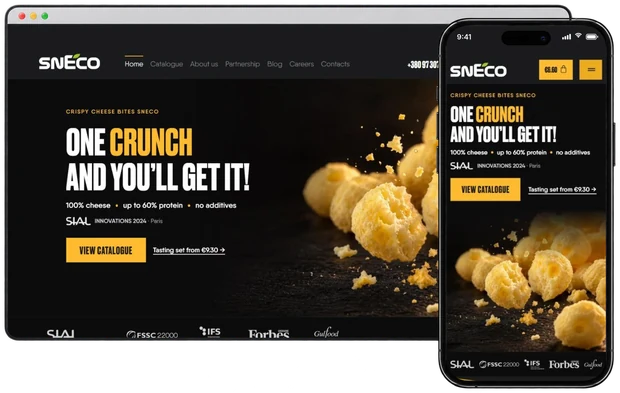 Cheese snacks
snEco
Multilingual store for a cheese snack producer. The catalog is organized by pack format, from a tasting set to a large bag, with free gifts by order total.
View case study
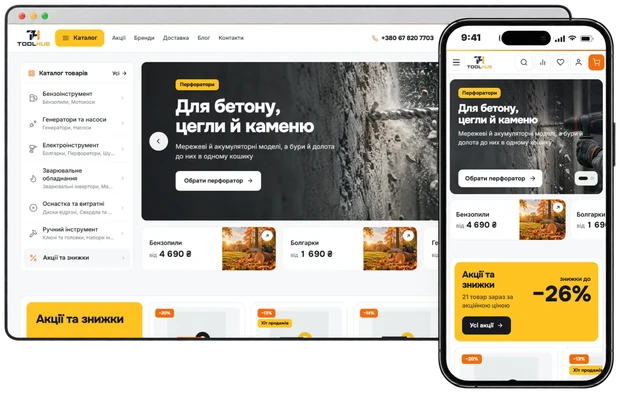 Power tools
ToolHub
Tool store with a catalog by brand, filters, product comparison and one-click purchase.
View case study
 Climate control equipment
TeploKholod
Climate control store with 900+ products. Air conditioner sizing by room area and an installation cost calculator.
View case study
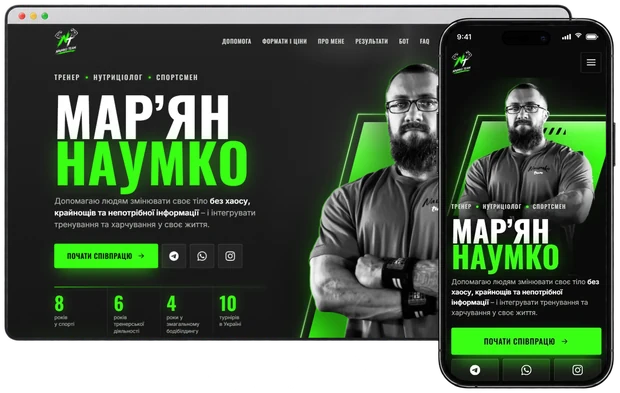 Online coach and nutritionist
Naumko Team
A landing page for a coach and nutritionist who works with clients online. Visitors start from their goal and see a matching format with what it includes and costs, and ready-made programs are sold in a Telegram bot with online card payments.
View case study
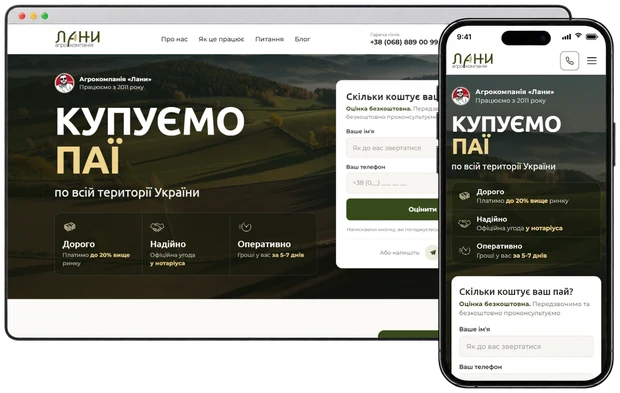 Farmland purchase
Lany
Landing page of an agricultural company that buys farmland plots from owners nationwide. An owner requests a free plot valuation from the hero section, and the plot details reach the manager in the CRM.
View case study
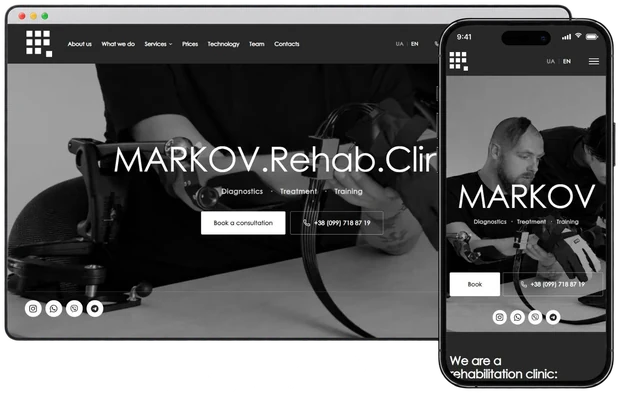 Rehabilitation clinic
MARKOV.Rehab.Clinic
A multilingual site for a clinic that combines acupuncture and other Chinese medicine methods with device-based rehabilitation. Patients, service members and course students each have their own sections, and booking a consultation starts with choosing a topic.
View case study
 Marketing agency
Pixelco
A website for a US agency that does lead generation, branding and web development. Each service line has its own page, and a conversation with a client starts with a Calendly booking.
View case study
 Handmade bags
UNO Atelier
Store for a bag brand where every bag is handwoven by one artisan. A collection by bag type, a color filter, a slide-out cart and online payment for local and international buyers.
View case study
 Beauty studio
RAK Beauty Project
A website for a Vienna studio offering laser hair removal, cosmetology and podiatry. Clients see the price for their area, book online and can buy a gift card.
View case study
 Motorcycle riding lessons
Karat Motorcycle School
Motorcycle school landing page where a beginner and a car driver each get their own course after three questions. Next to it are plans with the full price, training grounds with photos and the path to a license step by step.
View case study
 Gift sets
Cherry Merry
A store of handmade gift sets. Shoppers find a gift by who it is for and which holiday, or build their own in a gift box builder with a handwritten card.
View case study
 Women's clothing
ByWoman
An online store of women's dresses. Shoppers find a dress by occasion or length, pay by card and know the return terms before they order.
View case study
The team that builds your site also runs its ads, SEO and support. When something needs changing a year later, the people who wrote the code make the change.
The “from” price is for the smallest version of the project, and the exact figure comes after the brief. You pay in two parts, 50% before work starts and 50% before launch.
We work under a contract. See all prices on the Pricing page.
An integration costs from $200. We confirm the exact amount after a brief. It depends on the number of systems, one-way or two-way sync, the number of products and fields, whether a ready-made app exists for your platform and custom rules, such as several warehouses or wholesale prices.
Orders, leads, payments and statuses are synced, and the exact fields come from the system on the other side. A CRM usually gets orders and leads with contact details, products, shipping, payment and UTM tags, and sends statuses back to the site. QuickBooks or Xero get orders as invoices or sales receipts. Stripe, PayPal or Square report the payment status, and ShipStation or Shippo return the label and tracking number.
We agree on the frequency for each project. It depends on how the system provides data, its API limits and the number of products. Orders go to the CRM right after checkout, without manual export.
Yes. On Shopify many connections come from ready-made apps in the Shopify App Store, and we build the rest through the Shopify API and the API of the other system. WooCommerce has ready-made plugins for Stripe, PayPal, Square, ShipStation, Klaviyo and most CRMs, and we set them up and extend them when needed.
Yes. Orders from the site go to QuickBooks Online or Xero as invoices or sales receipts with the customer, items, shipping and tax, and payments are recorded against them. Both systems have open APIs, and for Shopify and WooCommerce there are ready-made connectors that we set up and adjust.
Yes, as an integration. We send products, prices and stock from your store to Amazon, eBay and Etsy through their APIs or a feed app, and bring orders back where the API allows.
Zapier or Make fit when both services have ready-made modules and the volume is moderate. They are faster to set up, but their plans are priced by usage. For large catalogs and frequent stock updates a direct API integration is more reliable.
Yes, if the site runs on WordPress, WooCommerce, Shopify or Webflow. First we review the code, plugins and access, so the sync does not break existing features. For other platforms we check whether they have an API.
Integration connects your site to the CRM you already use. Implementation includes choosing the system, setting up sales stages, importing your customer base and training materials for the team, and it is a separate service in the automation section.
You get an alert by email or in Slack, and the order stays on the site and is not lost. We fix bugs in our work for free, and this guarantee is lifetime. If a service changes its API, we update the sync under a support contract.
Choose the systems and your site platform. We reply with what can be connected and what data we need to estimate the price.
What should we connect to your site?
What is your site built on?
Thank you!
Get a quote
Thank you!